
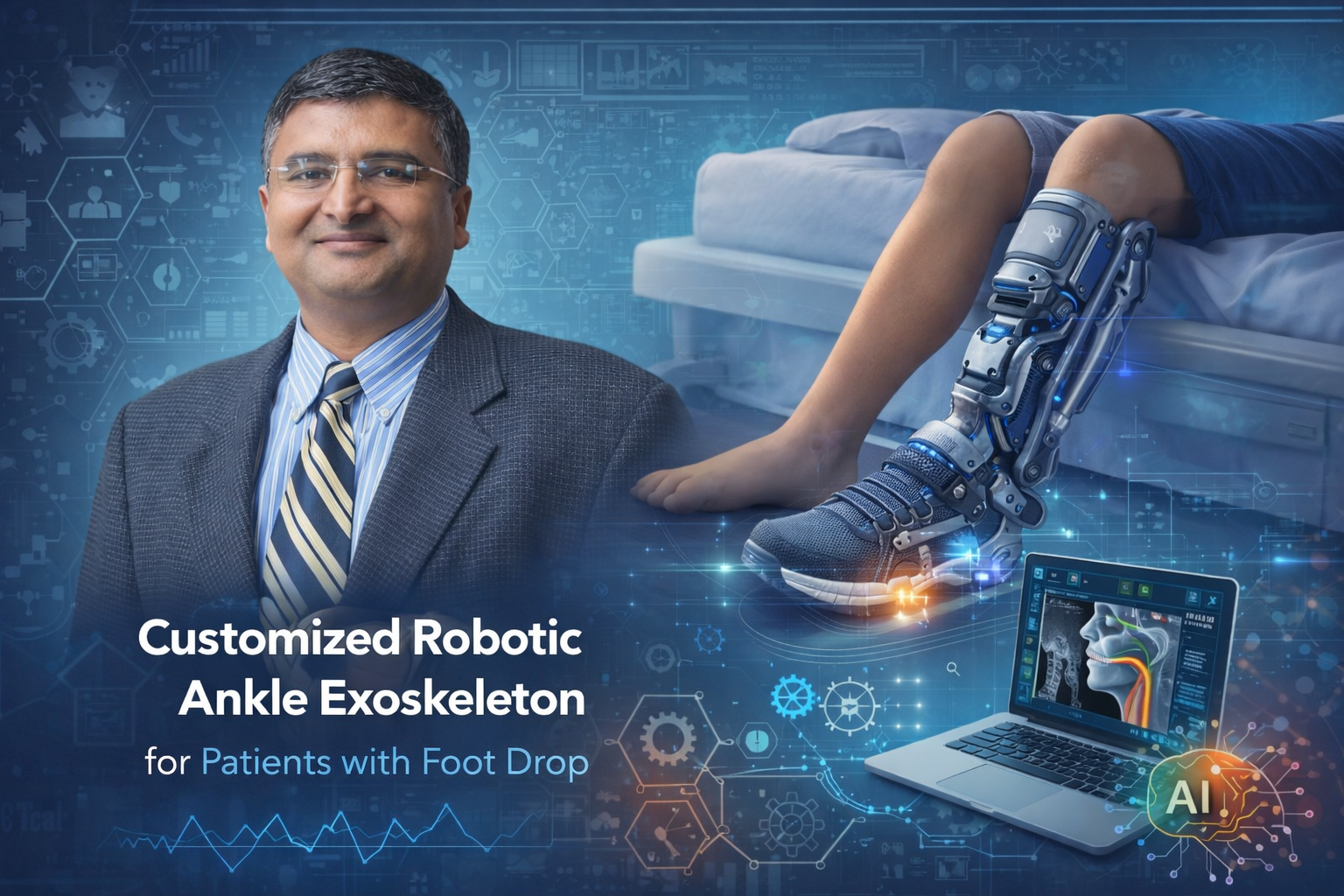
Customized Robotic Ankle Exoskeleton for Foot Drop
Foot drop is a common gait impairment affecting both pediatric and adult populations, characterized by difficulty lifting the front of the foot during walking. It is frequently seen in individuals with conditions such as cerebral palsy, spina bifida, hereditary neuropathies, and other neuromuscular disorders. Left untreated, foot drop can lead to increased fall risk, reduced endurance, and compensatory gait patterns that impact overall mobility and quality of life.
Traditional solutions, such as ankle-foot orthoses (AFOs), provide stability but restrict natural ankle motion, limiting push-off power and interfering with activities like running, jumping, and kneeling. This project addresses these limitations through the development of a customized robotic ankle exoskeleton system designed to restore more natural gait mechanics while maintaining mobility and function.
Project Overview
The Challenge
Foot drop affects approximately 20% of patients evaluated in motion analysis centers at Shriners Children’s Greenville, highlighting a significant unmet clinical need.
Current Orthotic Solutions:
- Provide passive support rather than active assistance
- Limit plantarflexion, reducing push-off power
- Restrict natural movement during everyday activities
- Do not adapt dynamically to patient-specific gait patterns
For pediatric patients, these limitations can impact not just mobility but also confidence, independence, and social participation.
The Innovation
This project introduces a robotic ankle exoskeleton system designed to actively assist ankle movement during walking. Unlike traditional orthotics, this system:
- Supports dorsiflexion during swing phase (foot clearance)
- Preserves plantarflexion for natural push-off
- Enables more biomechanically accurate gait patterns
- Can be customized to individual patient needs
By combining rehabilitation robotics with patient-specific design, this approach moves beyond passive support toward active mobility enhancement.
Objective
To develop a customized robotic ankle exoskeleton that improves gait efficiency, mobility, and quality of life for patients with foot drop.
Current Phase
The project successfully advanced early-stage development of the robotic exoskeleton system and contributed to foundational research supporting future innovation in rehabilitation robotics.
Potential Impact
Long-term, this innovation could redefine how clinicians approach gait rehabilitation—shifting from passive support to adaptive, intelligent assistance systems.
![[Add inline image alt text for Customized Robotic Ankle Exoskeleton for Foot Drop]](/sites/default/files/2026-04/Robotic%20ankle%20exoskeleton%20for%20foot%20drop.png)
Interested in collaborating or supporting this work?
We welcome clinical partners, research collaborators, and supporters who share a commitment to advancing pediatric innovation. Reach out to connect with the project team or explore related work across GTPIN.